Aluminum Frame Glass Cabinet Doors Guide
Aluminum-framed glass doors keep the frame as a thin line and let the glass carry the look. This guide covers narrow and wide frames, pivot doors, pin-hinge doors and vintage-style doors, along with hinge selection, glass types, hardware and what to confirm before ordering.
2026/11/19
Reading volume: 0
News Details
What Are Aluminum Frame Glass Doors?
An aluminum frame glass door is a cabinet or furniture door built from a narrow extruded aluminium frame around a single glass panel. The frame carries the hinges, holds the glass and defines the visible line; the glass carries almost the whole face. Used on kitchen wall units, wardrobes, display cabinets, bars and built-in units, it is the door type that lets a cabinet show what is inside instead of hiding it.
The reason it is specified in aluminium rather than wood is dimensional: a wood frame needs a wide stile and rail to stay straight on a tall door and still moves with the seasons, while an aluminium frame does not take up moisture and can be a fraction of the width for the same stiffness. That is what makes the narrow frame possible.
Anbangni (Chengdu Anbangni Smart Home Co., Ltd.)has worked in the furniture industry since 2002 and produces whole-house custom furniture at two bases, in Changzhou and Chengdu, on German IMA and Homag production lines, with projects delivered in more than 200 cities in China. Its glass door system covers five door types — hinged narrow frame, top-and-bottom pivot narrow frame, wide frame, pin-hinge and vintage-style — together with the glass door hardware that holds them. Because the frames, the cabinet carcasses and the panels behind the glass are produced in the same specification, the frame line and the interior it reveals are set together rather than matched afterwards.
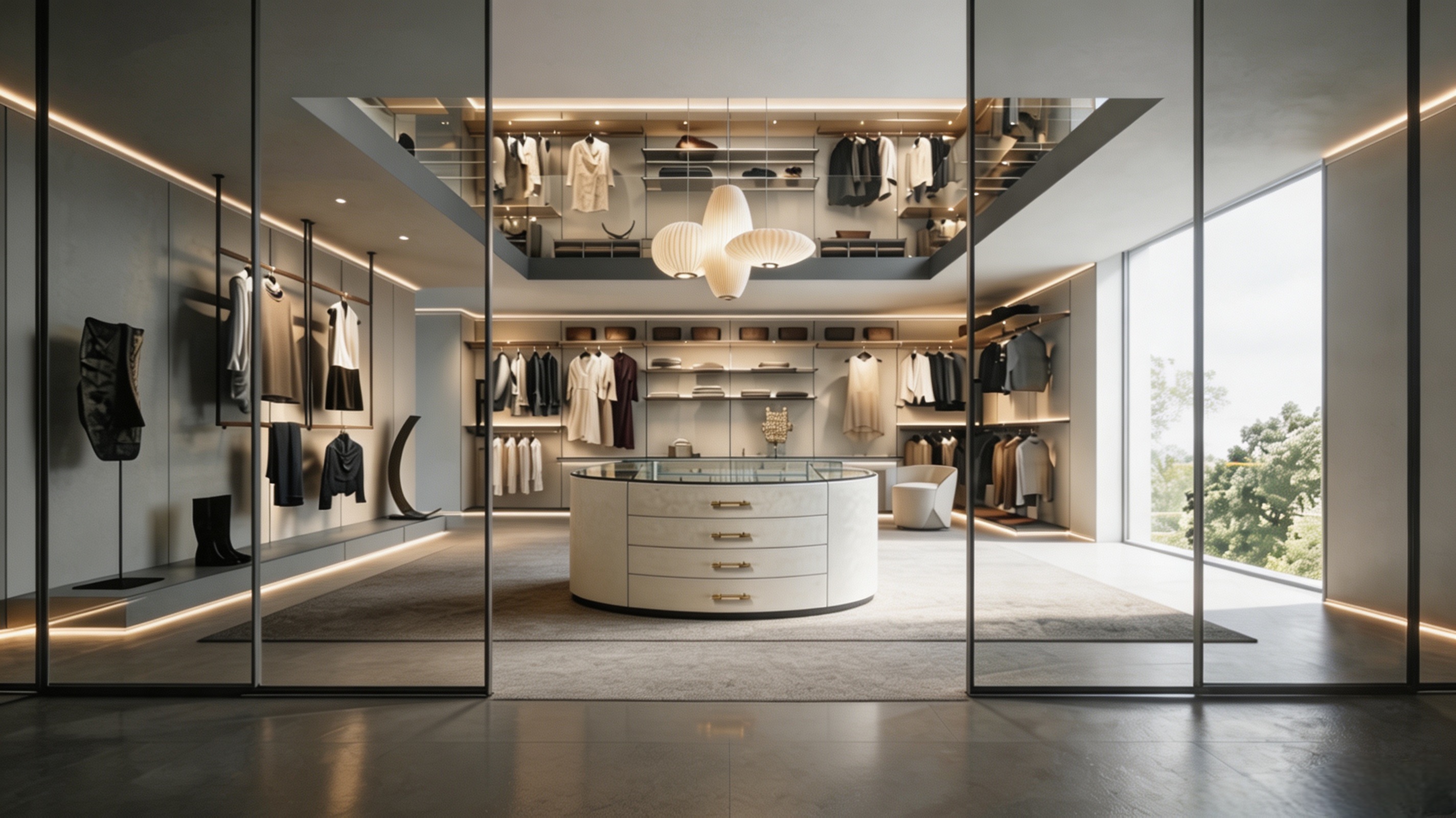
The five door types in the range differ in how the leaf is carried and how much frame is visible, which is the practical way to choose between them:
| Door type | How it is carried and how it reads | Where it usually fits |
| Hinged narrow frame | Side hinges concealed in the frame; a thin visible frame on all four sides | Kitchen wall units, wardrobes, display cabinets |
| Top-and-bottom pivot narrow frame | Pivot at top and bottom; no vertical side frame, so the leaf reads as a sheet of glass | Full-height wardrobe and display runs where the edge must stay clean |
| Wide frame | A broader visible frame that carries more visual weight | Traditional and industrial schemes, larger cabinet fronts |
| Pin-hinge | Small hinges at the top and bottom corners; minimal hardware on the leaf | Narrow cabinets and lighter leaves where a pivot is not practical |
| Vintage style | Frame and glass pattern used as the decorative element | Feature cabinets, bars, interiors with a period reference |
Narrow Frame Glass Cabinet Doors: Why Frame Width Sets the Look
Frame width is the first design decision: a narrow frame keeps the glass area large and the mullion almost invisible, so the eye goes to the contents, while a wide frame keeps the cabinet reading as a piece of joinery. What matters most is that one frame width is used across a run, because two different widths look like two different cabinets.
The narrow frame shows every error: a door cut slightly out of size, a pair that does not meet evenly, a gap that wanders — all visible at once, because there is no wide frame to absorb the tolerance. That is why narrow-frame doors are made to the actual opening and why the carcass has to be square before the doors are hung.
Two details decide whether a narrow-frame run looks resolved: the gap between leaves should be constant from first pair to last, which means setting carcass dividers from one reference; and a frame visible from inside as well as outside has to be finished on both faces.
A wide frame gives the cabinet more presence in a traditional or industrial room and tolerates a slightly out-of-square opening, but it hides more of what is behind it — right for a pantry, wrong for a display cabinet.
Pivot Hinge Glass Doors: Top-and-Bottom Mounting
A top-and-bottom pivot door removes the vertical frame entirely: the leaf turns on a pivot at each end, so the opening edge is a clean line of glass and the cabinet reads as an opening in a plane. It is the most architectural of the types and the least forgiving.
With no side frame there is nothing to hide a tolerance: pivots that are not on the same vertical line make the leaf bind or swing open on its own, and a pivot set too far in or out fouls the cabinet side or opens the closing gap. All of it is decided at the drilling stage, before the glass goes in.
A pivot carries the leaf's weight at two small points, so the cabinet top and the plinth have to take that load and stay rigid, and the plinth has to be level — a pivot door on a sloping floor hangs unevenly however well it is adjusted.
Pin-hinge doors are the lighter relative: small hinges at the top and bottom corners suit narrow cabinets and lighter leaves, with a similar visual result but a different load path, so the hinge series must match the leaf weight.
Glass Cabinet Door Hinges: Load, Concealment and Adjustment
Glass doors need their own hinge family. A standard cabinet hinge is designed for a wood or board door with a drilled cup and a screw-fixed plate; a glass door is heavier for its size, its edge cannot be drilled the same way, and the frame it fixes into is a thin aluminium profile with a specific groove. Four requirements follow.
Load capacity comes first. A glass leaf weighs more than a board leaf of the same size, and the weight sits further from the hinge line on a tall door. The hinge series has to suit the leaf weight and height, and the number of hinges has to follow the height rather than the width. A tall glass door on too few hinges will drop at the far corner, and because the frame is thin there is no material to hide the correction.
Concealment is the second: on a narrow frame the hinge is either inside the profile or visible on it. Concealed hinges need a precise groove in the aluminium, decided at the profile stage; surface-mounted hinges are simpler but show, which suits an industrial scheme and fails in a minimal one.
Adjustment is the third: three-way adjustment allows the gaps to be equalised once the carcass has settled, and without it a run of glass doors can only be corrected by re-drilling, which is not possible on an anodised profile.
The fourth is closing behaviour. A heavy glass leaf closing without damping lands hard, and the sound is the first thing a client notices. Hydraulic or soft-close hinges are the usual answer on tall leaves and on any door above hand height. On a handle-free scheme, the hinge also has to be compatible with the opening mechanism, which is a separate decision covered below.
Glass Types for Cabinet Doors
The glass decides how much of the cabinet is seen and how the interior is read. The common options behave differently, and the choice should follow what the cabinet holds rather than the style of the room.
Clear glass is for display — glassware, china, a lit bar — and shows everything, including the back of the cabinet, so the interior finish and lighting become part of the design. Frosted or acid-etched glass diffuses light while hiding detail. Tinted glass quiets a bright interior and reduces glare. Reeded or textured glass adds pattern and breaks up the reflection. Mirror hides the contents and reflects the room instead.
Safety is not optional: glass in a cabinet door should be tempered or laminated, because a door is a moving part at hand height. Treat it as a specification item and confirm it with the glass supplier.
Two interactions matter. Thickness against the frame profile: the groove is cut for a glass thickness, and a wrong pane either rattles or will not seat. Lighting: on clear glass a strip behind a shelf shows through as a line, so glass and lighting are chosen together; on frosted or reeded glass the same strip becomes a soft glow.
Vintage Style Glass Cabinet Doors
Vintage-style glass doors — often described in Chinese projects as mid-century style — take the frame and the glass pattern as the decorative content. Instead of hiding the frame, they use it: a wider profile, often in a dark or warm metallic finish, divided into panes or paired with reeded glass, so the door reads as a piece of period joinery rather than as a sheet of glass.
It works where the room already carries a period reference — a bar, a study, a dining room with timber and brass — and fails in a minimal interior, where the frame becomes the loudest line in the room.
Three details decide the result: the frame finish has to relate to the other metal in the room, since a warm brass frame beside a black aluminium window is a conflict rather than a contrast; the glass pattern changes how the contents read, so it is chosen with the interior; and the frame width should follow the panel division, because a door divided into four panes needs a frame heavy enough to hold the pattern.
Cabinet Glass Door Hardware: The Supporting Parts
The hardware package is what turns a frame and a pane into a working door, and it is the part most often left out of the specification: hinges and pivots, the handle or integrated pull profile, the gaskets that hold the glass, the corner connectors that tie the profiles together, and the catches that keep the leaf closed.
Handles divide into three approaches: a surface handle fixed through the frame, simple but face-interrupting; an integrated profile built into the frame as a shaped edge on the opening side, keeping the face uninterrupted; and a push latch or magnetic catch, which suits doors opened occasionally but not a door used every day.
Gaskets decide whether the glass sits without rattling and whether the door closes solidly; corner connectors decide whether the frame stays square, since friction-fitted corners open up at the mitre under the weight of the glass.
What to confirm before ordering: that the hinge series matches the frame profile groove, that the handle or pull is compatible with the opening method, that the glass thickness matches the gasket, and that the corner connectors are specified for the frame size rather than chosen on site.
Aluminum Frames Compared with Wood Frames
Both are legitimate, and the choice is usually made by the room. An aluminium frame stays straight on tall leaves, does not move in a kitchen or bathroom, allows a much narrower visible frame, and wipes clean without repainting. Its limits: it shows errors, a dent cannot be sanded out, and the frame is made to the opening rather than adjusted on site.
A wood frame is warmer in the hand, can be finished to match the cabinet exactly, and is more forgiving of an irregular opening. Its limits are movement on full-height doors and the frame width needed to keep it straight, which reduces the glass area.
The practical rule: use aluminium where the frame should disappear or where the door is tall, in a wet or steamy room, or in a run that includes metal elsewhere. Use wood where the glass door has to sit inside a timber scheme and the frame is meant to be seen.
How to Specify Aluminum Frame Glass Doors Before Ordering
The order of decisions is: opening, door type, frame, glass, hardware, gap, installation. Start with the actual opening size and the cabinet depth, because the frame sits inside the carcass and the door has to clear the interior fittings. Then choose the door type — hinged, pivot, pin-hinge, wide frame or vintage — because it decides the drilling and the frame profile. Then fix the frame finish and width. Then choose the glass, with safety glass confirmed and the lighting plan checked against it. Then select the hardware: hinge or pivot series, handle or pull, gasket and corner connectors. Then agree the gap and the closing behaviour, including soft-close where the leaf is heavy or high.
The output is a door schedule per opening: leaf size, door type, frame profile and finish, glass type and thickness, hinge or pivot reference, handle or pull, gap dimension, and the assembly sequence. With that schedule the carcass can be checked for square and the doors made to the opening instead of adjusted on site.
Anbangni produces glass door systems, cabinet systems, interior doors and wardrobe interiors for whole-house projects on German IMA and Homag lines at its Changzhou and Chengdu bases. For project enquiries, send the opening schedule and the interior each glass cabinet will hold, together with the frame finish you intend to use elsewhere in the room.


