Laser Edge Banding for Cabinet Panels: Why It Matters in Premium Cabinetry
Learn why laser edge banding improves the appearance, durability, and detail quality of cabinet panels in high-end cabinetry and whole-home furniture.
2026/10/09
Reading volume: 1
News Details
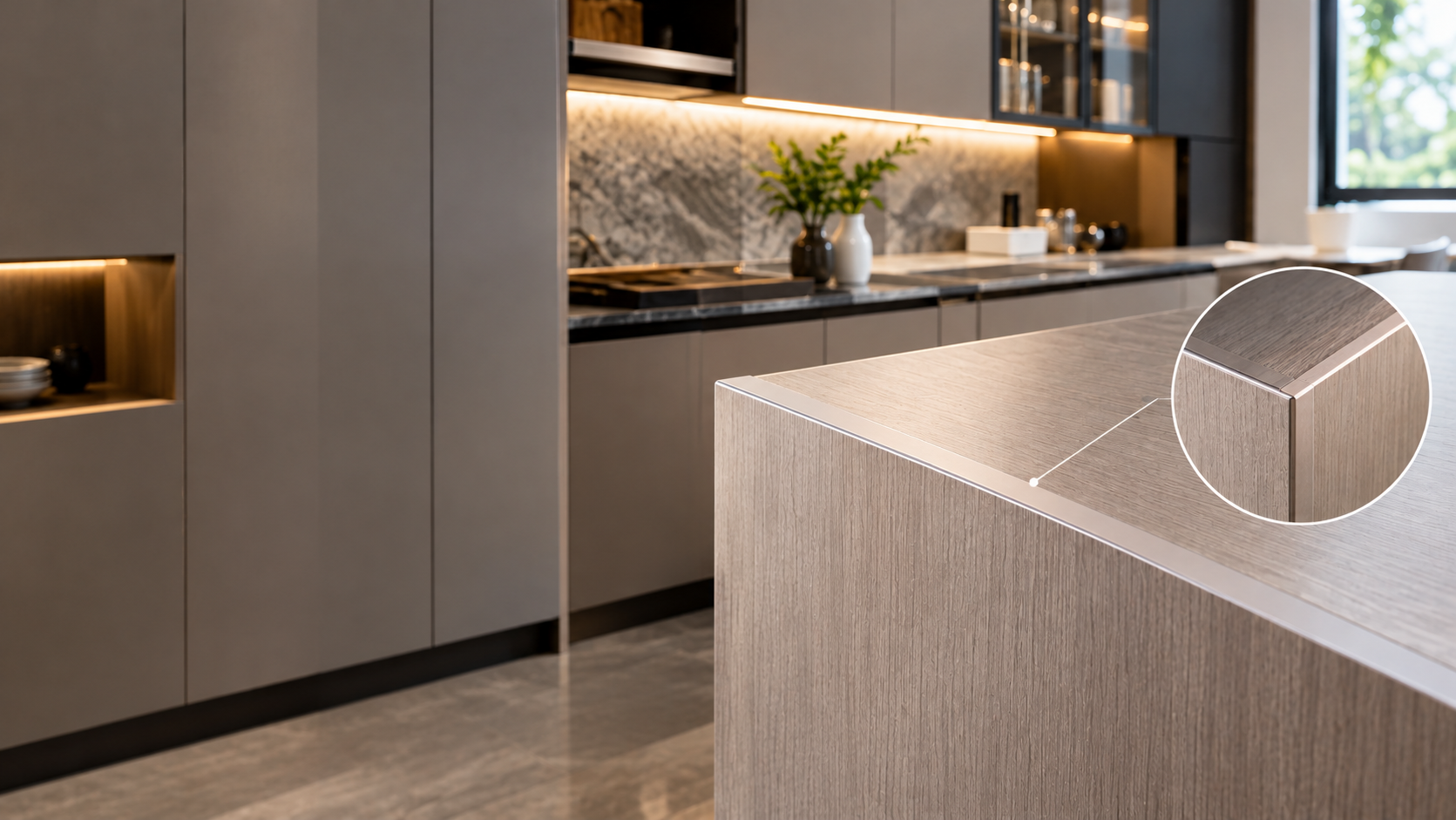
Premium cabinetry is not only about the surface finish. Every detail matters, including the edges of each panel.
For modern kitchens, wardrobes, and whole-home furniture, visible panel edges can strongly affect the final look. Traditional edge banding can sometimes leave a visible glue line or a small difference between the board surface and edge. For high-end projects, these small details can become noticeable.
That is why laser edge banding cabinet panels are gaining attention in premium furniture manufacturing. The technology creates a cleaner connection between the decorative surface and the edge band, helping manufacturers achieve a more refined result.
What Is Laser Edge Banding?
Laser edge banding is an advanced process used to bond an edge band to a cabinet panel without relying on a conventional visible glue layer.
During the process, laser energy activates a functional layer on the edge band. The activated layer bonds with the prepared panel edge. As a result, the connection can be very thin and uniform.
This is different from traditional hot-melt edge banding, where adhesive is applied between the panel and edge band.
The main goal is simple: create a cleaner and more integrated panel edge.
Why Edge Quality Matters in Premium Cabinetry
In premium cabinetry, customers often judge quality through small details.
A cabinet door may have a beautiful wood grain, matte finish, or textured surface. However, if the edge shows an obvious glue line, uneven bonding, or poor color matching, the overall appearance can feel less refined.
This is especially important for:
-
High-end kitchens
-
Custom wardrobes
-
Walk-in closets
-
Luxury residential projects
-
Hotel furniture
-
Whole-home custom furniture
-
Modern minimalist interiors
In these applications, cabinet panels are often viewed from different angles. Therefore, edge quality becomes part of the overall design.
1. Seamless Edge Banding Creates a Cleaner Look
One of the main benefits of laser technology is seamless edge banding.
Because the bonding layer is extremely thin, the transition between the decorative panel surface and edge band can look more integrated. There is less visual interruption along the edge.
This is particularly useful for dark, matte, wood-grain, and solid-color panels.
For minimalist furniture, the cleaner the edge, the more complete the design can look.
2. Better Visual Continuity for Decorative Panels
Modern cabinet design uses many decorative finishes. Wood grain, stone patterns, solid colors, and soft-touch surfaces are common choices.
An edge band should work with the panel instead of becoming a separate visual element.
For example, an 18mm decorative board with a carefully matched edge can create a consistent appearance across cabinet doors, side panels, shelves, and other visible parts.
This matters even more when designers use large flat surfaces and simple cabinet shapes. With fewer decorative elements, small manufacturing details become easier to see.3. Stronger Resistance to Moisture and Dirt
The edge of a cabinet panel is also a functional area.
If the edge connection is poorly made, small gaps may collect dust or allow moisture to reach the board core. Over time, this can affect the appearance and service life of the panel.
A well-controlled edge-banding process creates a more closed edge.
For kitchen and bathroom applications, this is especially valuable because cabinet panels may be exposed to humidity, splashes, and frequent cleaning.
However, edge banding should always be considered together with the quality of the board core and the complete cabinet construction.
4. PUR Edge Banding Panels vs. Laser Edge Banding
PUR edge banding panels
are also widely used in quality furniture production. PUR adhesives provide strong bonding and good resistance to heat and moisture. They are suitable for many cabinet and furniture applications.Laser edge banding takes a different approach by using laser activation to create the bond.
The choice depends on the project, panel material, edge material, equipment, production process, and required finish.
For premium cabinetry, buyers should therefore look beyond the name of the technology. They should also check:
- Edge appearance
A capable manufacturer should be able to recommend the right edge-banding method according to the project requirements.
5. Better Results on High-End Cabinet Boards
The quality of edge banding starts with the quality of the panel.
A
premium cabinet board supplier
should control both the decorative surface and the panel processing stage. Good edge results require accurate cutting, stable panel dimensions, clean edges, and suitable edge materials. This is why edge banding should not be treated as an isolated production step.Instead, it should be part of a complete cabinet manufacturing system.
At Anbangni, whole-home custom furniture production combines panel processing, cabinet manufacturing, hardware systems, and detailed finishing. The company has focused on custom whole-home furniture since 2002 and operates production facilities in Changzhou and Chengdu with more than 20,000 m² of manufacturing space. Its facilities use automated production lines from German IMA and HOMAG.
6. Laser Edge Banding Supports Modern Cabinet Design
Modern interiors often favor simple shapes and clean surfaces.
There may be fewer handles, fewer decorative lines, and fewer visible joints. As a result, the edge of a cabinet panel becomes more important.
Laser edge banding can support this design direction by reducing the visual impact of the edge connection.
It works well with:
- Flat-panel kitchen cabinets
The result is a cabinet that looks more like one complete piece rather than several materials joined together.
What Should Buyers Check Before Choosing a Supplier?
For furniture brands, distributors, and project buyers, choosing the right supplier involves more than checking whether a factory offers laser edge banding.
Before placing an order, ask about:
Panel specifications:
Confirm thickness, core material, surface finish, and dimensional tolerance.Edge materials:
Check whether the edge band matches the panel in color, texture, and gloss.Processing equipment:
Ask about the equipment used for cutting, edge preparation, and edge banding.Quality control:
Check how the supplier controls edge gaps, bonding quality, panel dimensions, and surface defects.Sample production:
Request samples before mass production, especially for premium or customized projects.Production consistency:
For large projects, make sure the supplier can maintain the same finish across repeated batches. These points can help buyers avoid problems after installation.Why Edge Details Define Premium Cabinetry
Premium furniture is built from many small details.
The panel material matters. Hardware matters. Surface finish matters. Production accuracy matters. And edge quality matters too.
A well-made cabinet should look refined from the front, side, and even close up.
That is why technologies such as laser edge banding are becoming increasingly relevant to high-end cabinetry. They can help manufacturers create cleaner edges, stronger visual continuity, and a more integrated appearance.
For buyers looking for a
premium cabinet board supplier
, the best approach is to evaluate the complete manufacturing system rather than one production technique. Anbangni focuses on premium custom whole-home furniture and supports projects with advanced manufacturing, decorative cabinet panels, and integrated cabinet systems. Its experience covers customized kitchens, wardrobes, storage solutions, and other whole-home applications.When every edge, surface, and joint is carefully controlled, the difference can be seen in the finished cabinet.
Ready to Upgrade Your Cabinet Panel Edges?
If you are sourcing
laser edge banding cabinet panels
for kitchens, wardrobes, hotels, or whole-home furniture projects, choosing the right manufacturing partner can make a real difference. Anbangni provides customized cabinet and whole-home furniture solutions for professional buyers, furniture brands, designers, and project developers. From18mm decorative board
selection to edge banding, panel processing, and finished cabinet production, our team can help match materials and production methods to your project requirements.Contact Anbangnito discuss your panel specifications, request samples, and explore a customized solution for your next furniture project.


